Categories
Artificial intelligence

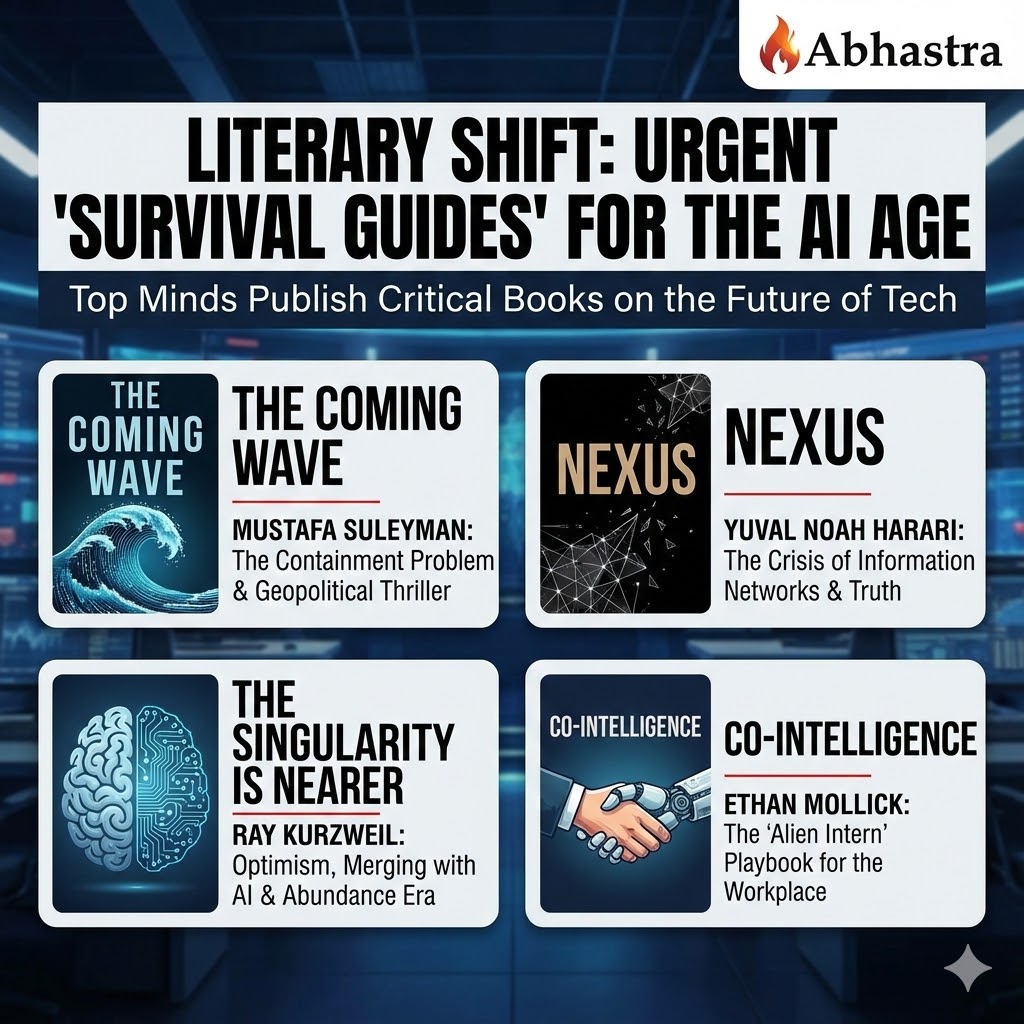
Literary Shift: Top Tech Minds Publish Urgent “Survival Guides” for the AI Age

The bookshelf of the modern CEO is undergoing a dramatic transformation. Gone are the days of biographies about Steve Jobs or Elon Musk; taking their place is a new genre of “future-shock” literature.

As Artificial Intelligence accelerates at an unprecedented pace in late 2025, a wave of high-profile authors—from deep-tech insiders to historians—are releasing critical works that attempt to map the uncharted territory of the next decade. These books are not merely predicting gadgets; they are redefining what it means to be human.

For readers looking to understand the tectonic shifts occurring in Silicon Valley and beyond, four titles have emerged as essential reading this year.

The Warning: Suleyman’s “The Coming Wave”

Leading the charge is Mustafa Suleyman, co-founder of DeepMind (now Google DeepMind). His book, The Coming Wave, is being cited by policymakers as a critical wake-up call.

Suleyman argues that we are approaching a convergence of AI and synthetic biology that poses a “containment problem.” Unlike nuclear weapons, which are hard to build, AI is becoming cheaper and more accessible. His reporting suggests that without immediate global regulation, the ability to create dangerous pathogens or cyber-weapons could fall into the hands of non-state actors. It is less a book about technology and more a geopolitical thriller about the fragility of the nation-state.

The Historian’s Perspective: Harari’s “Nexus”

Yuval Noah Harari, the historian who captivated the world with Sapiens, has returned with Nexus. While his previous works looked far into the past or distant future, Nexus tackles the immediate crisis of “information networks.”

Harari’s thesis is stark: Information is not truth. It is merely the glue that holds societies together. He warns that for the first time in history, we have created non-human agents (AI) capable of generating new ideas and making decisions. Nexus argues that if these networks remain unchecked, they could destroy the democratic institutions that rely on human discourse.

The Optimist’s Forecast: Kurzweil’s “The Singularity Is Nearer”

Offering a counter-narrative to the doom is legendary futurist Ray Kurzweil. In The Singularity Is Nearer, a sequel to his 2005 classic, Kurzweil doubles down on his prediction that humans will merge with machine intelligence by 2045.

Kurzweil’s writing remains unapologetically optimistic. He presents data suggesting that AI will not replace us, but rather “upgrade” us—solving the climate crisis, curing cancer, and extending human longevity. For investors and technologists, this book provides the roadmap for the “abundance” era.

The Playbook: Mollick’s “Co-Intelligence”

While Harari and Kurzweil debate the philosophy, Wharton Professor Ethan Mollick has provided the manual. His book, Co-Intelligence, has become the de-facto textbook for the white-collar workforce.

Mollick treats AI not as a search engine, but as an “alien intern”—incredibly smart, but prone to hallucinations. His report focuses on the practical application of Large Language Models (LLMs) in the workplace, arguing that those who learn to “invite the alien” into their workflow will see productivity gains of up to 40%, while those who resist face obsolescence.

Market Reaction

The popularity of these four titles signals a shift in public sentiment. “People are no longer looking for ‘how-to’ guides on coding,” says industry analyst Sarah Jenks. “They are looking for philosophical anchors. They want to know if their jobs, and their reality, will exist in ten years.”
Categories
Artificial intelligence

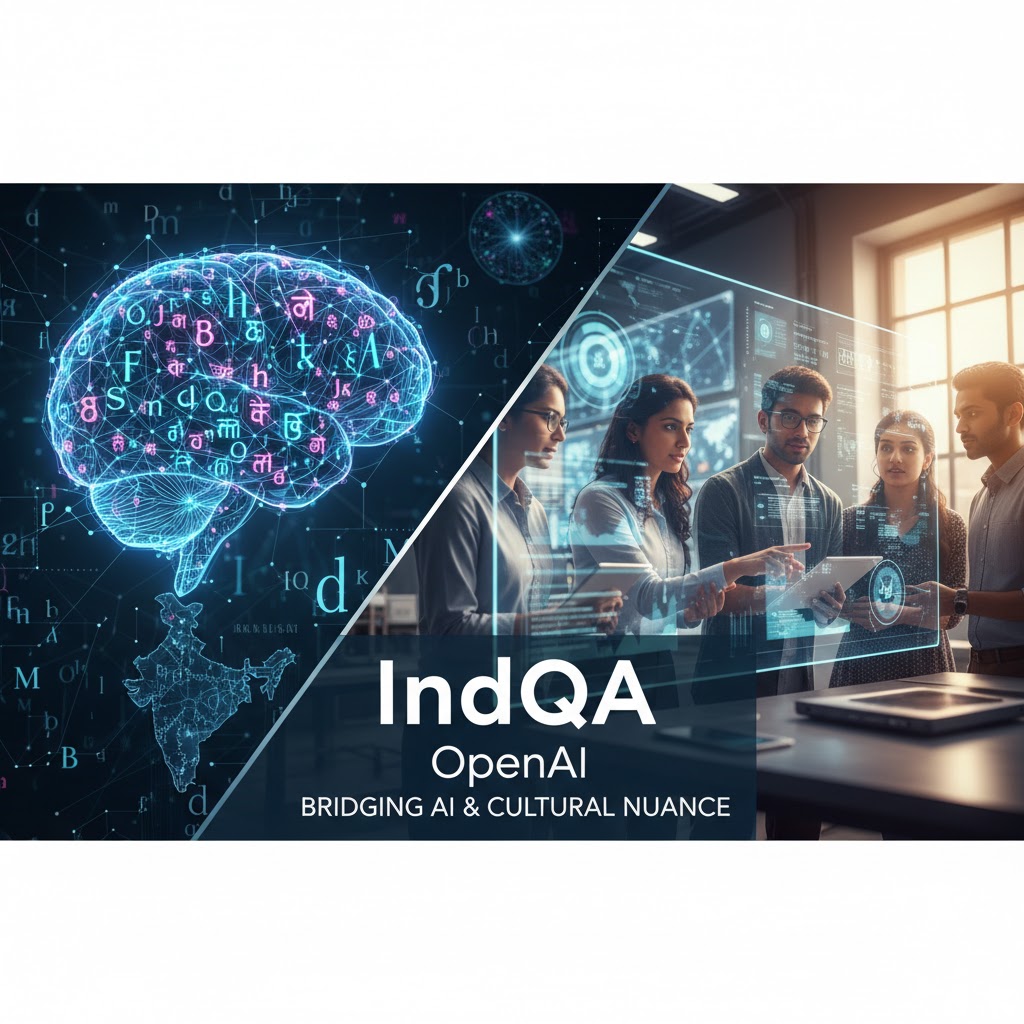
OpenAI Unveils “IndQA,” a Groundbreaking Benchmark Designed to Test AI Comprehension of India’s 12 Diverse Languages and Deep Cultural Nuances

In a major strategic move to enhance the multilingual and multicultural capabilities of its technology, OpenAI has officially introduced “IndQA.” This pioneering benchmark is meticulously designed to test how effectively artificial intelligence (AI) systems can comprehend and navigate the complex tapestry of India’s diverse languages, cultural nuances, and regional contexts.

The initiative marks a significant step in the global push for more inclusive AI, starting with one of the world’s most linguistically rich regions. With India standing as ChatGPT’s second-largest market, this move underscores OpenAI’s commitment to making its technology more reliable and attuned for non-English users.

A New Standard for Cultural Authenticity

Developed in close collaboration with a diverse group of 261 domain experts from across India, IndQA is a comprehensive and robust dataset. It comprises 2,278 high-quality questions that are not only challenging but also deeply embedded in the Indian context.

What truly sets IndQA apart from conventional benchmarks like MMMLU and MGSM is its development process. OpenAI states that the content is “natively written”—meaning it was conceptualized and written directly in the local languages by experts, not created in English and then translated.

This “natively written” approach is critical. It ensures that the phrasing, intent, and cultural context of each question are authentic, testing an AI’s genuine understanding of subtle nuances, idioms, and region-specific knowledge, rather than just its ability to process literal translations.

How IndQA Works: Beyond Multiple Choice

IndQA also introduces a more sophisticated evaluation method. It moves away from simple multiple-choice testing and adopts a “rubric-based evaluation system.”

Here’s the process:

  1. The Prompt: Each question includes a culturally contextual prompt written in one of the 12 Indian languages.
  2. Verification: An English translation is provided alongside the prompt, purely for verification and clarity for a global team.
  3. The Rubric: A detailed grading rubric, created by the domain experts, accompanies each question.
  4. The Ideal Answer: An expert-level, ideal answer is provided as a gold standard.

AI models are then assessed against the specific criteria within the rubric, which carry weighted scores. This allows for a far more granular evaluation of an AI’s performance, grading it on its grasp of nuance, its reasoning capabilities, and its cultural correctness—not just a simple right or wrong.

Comprehensive Linguistic and Cultural Scope

The IndQA benchmark is ambitious in its scope, covering a significant portion of India’s linguistic and cultural landscape.

  • 12 Languages: The dataset covers Bengali, English, Hindi, Hinglish, Kannada, Marathi, Odia, Telugu, Gujarati, Malayalam, Punjabi, and Tamil.
  • 10 Cultural Domains: The questions are drawn from a wide array of cultural and intellectual areas, including:
    • Architecture & Design
    • Arts & Culture
    • Everyday Life
    • Law & Ethics
    • Media & Entertainment
    • Religion & Spirituality
    • Sports & Recreation
    • And other core areas of Indian life.

OpenAI has already begun benchmarking its most advanced models, including GPT-4o, OpenAI o3, GPT-4.5, and the anticipated GPT-5, against this new standard to measure and improve their performance.

IndQA: At a Glance

  • Total Questions: 2,278
  • Collaborators: 261 domain experts from India
  • Languages: 12 (including Hindi, Tamil, Bengali, Telugu, etc.)
  • Cultural Domains: 10 (including Arts, History, Law, Daily Life)
  • Evaluation Method: Rubric-based grading (not multiple-choice)
  • Key Feature: “Natively written” content, not translated

The Future of Inclusive AI

India was strategically chosen as the starting point for this project, not only because of its market size but because nearly a billion Indians do not use English as their primary language.

Srinivas Narayanan, CTO of B2B Applications at OpenAI, emphasized the project’s goal, stating that the aim was to ensure models grasp “the nuances every culture cares about.”

The launch of IndQA is not an endpoint. OpenAI has stated that it plans to replicate this comprehensive framework in other regions and for other cultures, using the lessons learned from the IndQA project. This signals a clear and dedicated effort to build AI systems that understand people the way they naturally speak and think, regardless of their language, ultimately fostering a more inclusive and accessible AI for the entire world.