Imagine a city without traffic lights. Cars zoom through intersections, pedestrians run for their lives, and the biggest trucks bully the smallest scooters. It works—people get where they are going—but it is chaos. And if you get hit? Well, that is just the price of progress.
For a long time, this was the world of Artificial Intelligence.
Companies built algorithms that decided who got a loan, who got hired, and even who went to jail. It was a technological “Wild West.” If an AI discriminated against women or accidentally leaked your medical records, there was no global rulebook to say, “Stop. You can’t do that.”
Until a chilly day in Paris, in November 2021.
The Gathering in Paris
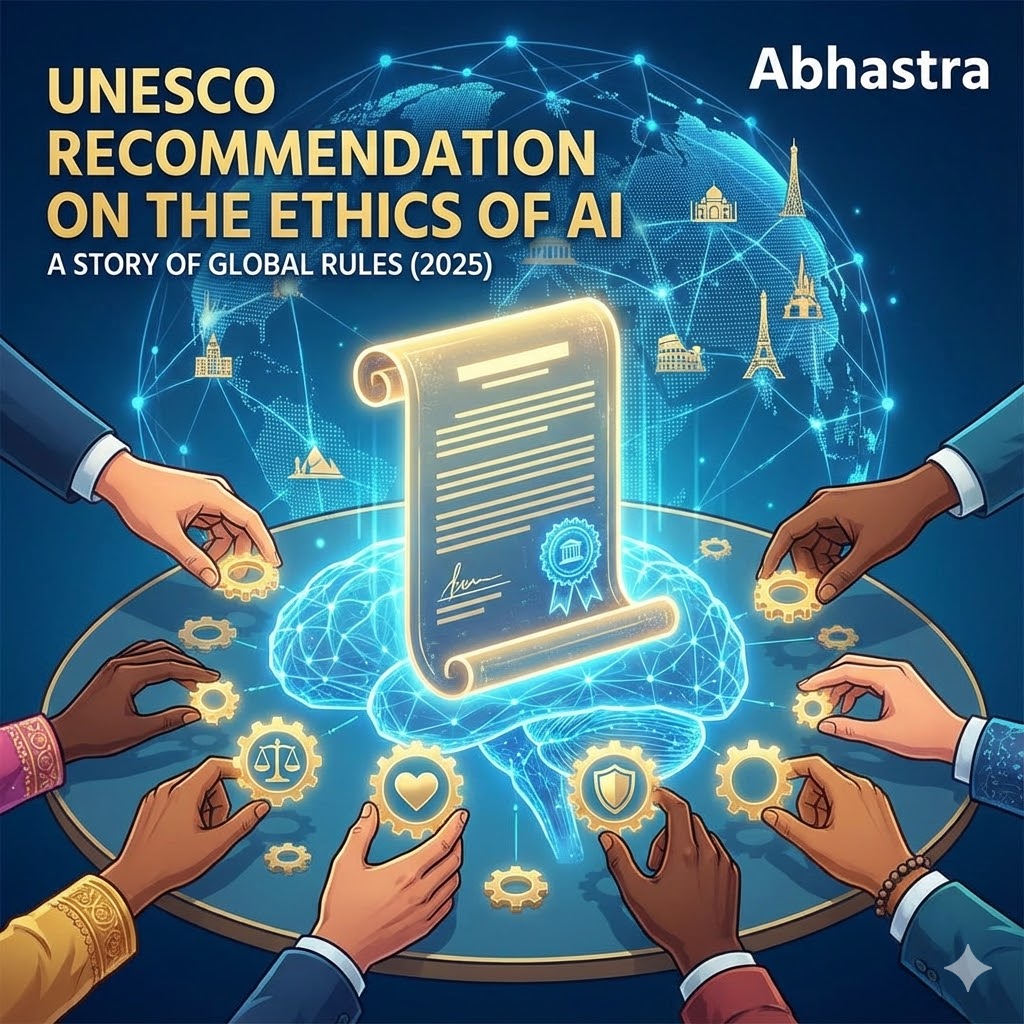
Inside the halls of UNESCO (The United Nations Educational, Scientific and Cultural Organization), representatives from 193 countries gathered with a single mission: to write a constitution for the digital age.
They weren’t there to ban AI or stop innovation. They were there to answer a deeper question: “How do we make sure these machines don’t lose their humanity?”
After months of heated debates and sleepless nights, they emerged with a historic document: The Recommendation on the Ethics of Artificial Intelligence.
It was the first time the entire world agreed on a “Soul” for the machine.
The 4 Pillars of the “AI Constitution”
This wasn’t just a boring legal paper. It was a promise built on four massive pillars. Imagine them as the four walls protecting us from a dystopian future:
1. Human Rights & Dignity (The Foundation)
The story starts here. The agreement stated that no algorithm is more important than a human being.
- The Rule: AI cannot be used for “Social Scoring” (like in Black Mirror) or mass surveillance that treats citizens like suspects. If an AI hurts human dignity, it must be shut down.
2. Environment & Ecosystems (The Breathing Room)
For the first time, AI wasn’t just seen as code—it was seen as a consumer of energy.
- The Rule: Training a massive AI model consumes as much energy as a small city. The recommendation forces companies to consider the carbon footprint of their digital brains. We shouldn’t burn the planet just to build a slightly better chatbot.
3. Diversity & Inclusiveness (The Open Door)
The delegates noticed a problem: most AI was being built by men in wealthy countries.
- The Rule: AI must not leave anyone behind. It demanded that datasets be diverse. If an AI can’t recognize dark skin tones or assumes all doctors are men, it is “defective” and unethical.
4. Peaceful & Just Societies (The Shield)
AI should be a peacemaker, not a weapon.
- The Rule: AI should not be used to manipulate democracy, spread hate speech, or deepen the divide between the rich and the poor.
The “Red Lines” You Should Know
The most dramatic part of this story is the “Red Lines”—the things UNESCO said we must never do.
- No “Black Boxes” in High Stakes: If an AI denies you a mortgage or a job, it must explain why. You have the “Right to Explanation.”
- Ban on Mass Surveillance: Governments cannot use AI to track innocent citizens without cause.
- Gender Equality: It explicitly calls for funding to get more women into AI coding, breaking the “Bro-Code” culture of Silicon Valley.
The Ending: A Compass, Not a Map
The UNESCO Recommendation is not a law that puts people in jail (yet). It is a “Soft Law”—a compass.
Before 2021, we were driving in the dark. Now, thanks to that agreement in Paris, every government from India to Brazil to France has a direction. They are rewriting their own laws to match this global standard.
The story of AI is still being written, but because of this recommendation, the main character isn’t the Robot. It’s Us.