For decades, the hoodie was just a piece of cloth. It was a symbol of comfort, a uniform for gym-goers, and occasionally a shield for celebrities hiding from paparazzi.
But in 2025, the humble hoodie has evolved. It is no longer just cotton and polyester; it is a weapon in the war between privacy and surveillance.
This is the story of the “Adversarial Hoodie”—the first piece of clothing designed not by a human, but by an algorithm, to defeat other algorithms.
The Problem: The Eyes are Everywhere
Imagine walking down a street in London, New York, or Beijing. Every few meters, a camera scans your face. Facial recognition software maps the distance between your eyes, the shape of your nose, and the curve of your jaw. In milliseconds, it knows who you are, where you have been, and who you are with.
To a human, you are just a person in a crowd. To the Machine, you are a data point.
Designers in Italy and New York began to ask a cyberpunk question: If AI is watching us, can we use AI to hide from it?
The Solution: The “Zebra” Glitch
Enter the concept of “Adversarial Patterns.”
A brand called Cap_able and researchers like Adam Harvey (creator of CV Dazzle) discovered a flaw in the machine’s brain. AI cameras are trained to recognize “patterns” of human faces. But if you overload the camera with too much conflicting data, the AI gets confused.
They fed millions of images into an AI designer and asked it to create a pattern that looked like “noise” to a computer but “fashion” to a human.
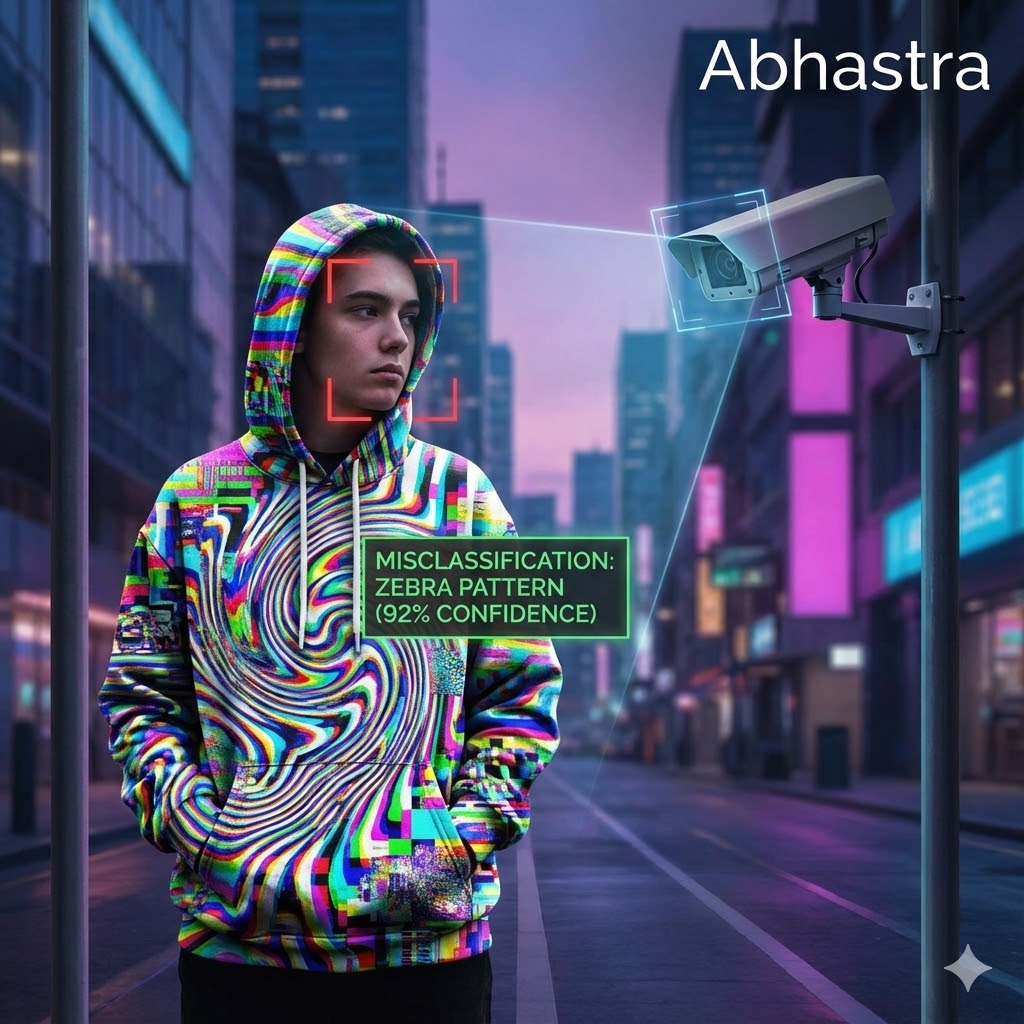
The result? A hoodie covered in strange, swirling, colorful shapes that look like a digital tie-dye or a corrupted image file.
How It Works (The Magic Trick)
When you wear this “Artificial Intelligence Hoodie,” something incredible happens in the digital world.
As you walk past a surveillance camera:
- The camera tries to lock onto your face.
- The pattern on your chest confuses the camera’s sensors.
- Instead of registering “Human: Male, 30s,” the AI panics. It might classify you as a “Giraffe,” a “Zebra,” or simply “Nothing.”
You haven’t covered your face. You aren’t wearing a mask. You are hiding in plain sight, protected by a “digital invisibility cloak” woven into your fabric.
The New “AI Aesthetic”
Beyond privacy, AI is changing how hoodies look.
We are seeing a surge in “Generative Streetwear.” Designers are using tools like Midjourney and DALL-E to create impossible fabrics—hoodies that look like they are made of melting chrome, bioluminescent moss, or liquid smoke.
One viral trend involved the “Kanye West style” oversized hoodies—generated entirely by prompts, with no human sketching involved. These designs are often seamless, eerie, and geometrically perfect in a way human hands rarely achieve.
The Future: The Living Hoodie
The story doesn’t end here. We are moving toward “Agentic Clothing.”
Tech insiders predict that by 2026, the “AI Hoodie” won’t just be a print. It will have chips woven into the fibers. It will change color based on your mood (reading your body heat), adjust its insulation automatically, and perhaps even vibrate to warn you when a camera is watching.
The hoodie is growing up. It used to keep you warm; now, it keeps you private.