
As temperatures begin to drop across the country, automobile experts are issuing a seasonal warning to vehicle owners: check your car battery now or risk being stranded.
According to roadside assistance data, battery-related breakdowns spike significantly during the winter months. Cold weather slows down the chemical reactions inside the battery, reducing its power output just when the engine requires more energy to start.
However, drivers do not need to wait for a mechanic to diagnose a failing battery. Here are the three standard methods recommended by technicians to test battery health at home.
1. The “Headlight Load” Test (No Tools Required)
For vehicle owners without technical equipment, the simplest diagnostic method involves using the car’s own electrical system to test the battery’s load capacity.
- The Procedure: With the engine turned off, the driver should switch on the headlights.
- The Test: Attempt to start the engine while observing the brightness of the lights.
- The Analysis:
- Steady Brightness: If the lights do not dim significantly while the engine cranks, the battery is holding a sufficient charge.
- Significant Dimming: If the lights dim heavily or flicker, the battery is struggling to provide enough current.
- Failure: If the lights go out completely, the battery is discharged or “dead.”
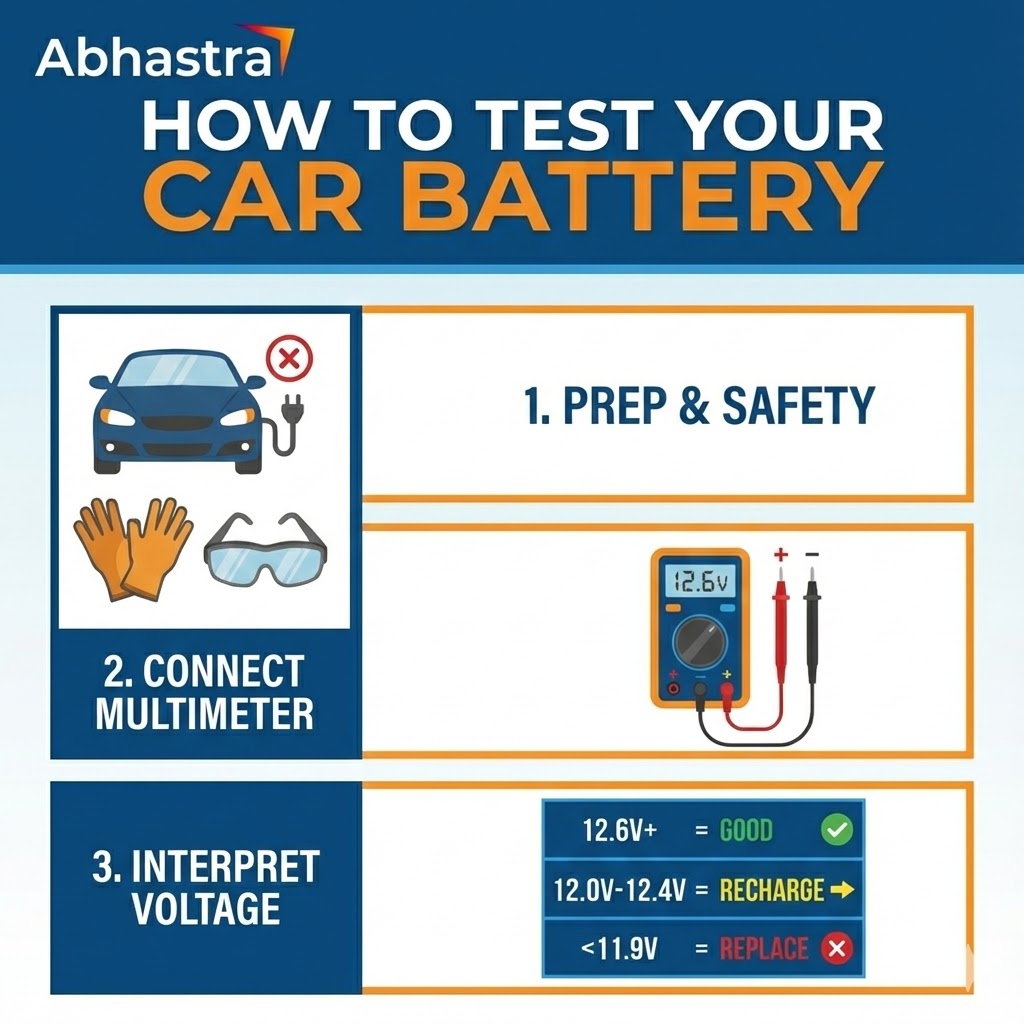
2. The Multimeter Test (Precision Method)
For a more accurate reading, experts recommend using a digital multimeter. This device measures the exact voltage and provides a clear indication of the battery’s state of charge.
Step-by-Step Guide:
- Set the multimeter to 20V DC.
- Connect the red probe to the positive terminal (+) and the black probe to the negative terminal (-).
- Take the reading while the car is completely off (at least one hour after driving to remove “surface charge”).
Voltage Reference Data
- 12.6 Volts or higher: The battery is fully charged (100%).
- 12.4 Volts: The battery is at approximately 75% charge.
- 12.0 Volts – 12.2 Volts: The battery is weak (25-50%) and requires immediate charging.
- Below 11.9 Volts: The battery is considered dead or deeply discharged.
3. The Visual Inspection
Before performing electrical tests, owners are advised to check for physical signs of deterioration. “Corrosion is a silent killer for batteries,” states senior auto technician Rajesh Kumar.
What to look for:
- Blue or White Powder: Corrosion around terminals can block electrical flow. This can often be cleaned with a baking soda and water solution.
- Swollen Case: If the battery casing looks bloated or square, it indicates internal damage caused by overcharging or extreme heat. These batteries are unsafe and must be replaced immediately.
- Age Factor: Check the manufacturing date code. Most standard lead-acid batteries have a lifespan of 3 to 5 years. If a battery is older than four years, proactive replacement is recommended regardless of test results.
Summary
With winter mornings approaching, a weak battery that worked in summer may fail to start an engine in lower temperatures. A five-minute check this weekend could prevent a breakdown during the morning commute.